Miscarriage After Seeing a Heartbeat: What the Research Says
A confirmed fetal heartbeat cuts miscarriage risk by roughly 60%. Here is what the research shows about risk after cardiac activity is detected, and what it means for your pregnancy.
Quick Answer
Once a fetal heartbeat is confirmed on ultrasound, miscarriage risk drops by approximately 55–65% compared to a pregnancy at the same gestational week without confirmed cardiac activity. For a 30-year-old with no prior losses at week 8, that means going from around 5.5% risk to roughly 2.2%.
A confirmed heartbeat is the single strongest drop in miscarriage risk you'll see during the first trimester. Seeing cardiac activity on ultrasound between 6 and 10 weeks cuts the chance of loss by roughly 55–65% compared to pregnancies at the same week without confirmed cardiac motion. The data behind this reassurance is solid and holds across age groups.
This article breaks down what the research actually shows about miscarriage risk after heartbeat confirmation, including how age and gestational week interact with the heartbeat factor.
When Heartbeat Detection Becomes Possible
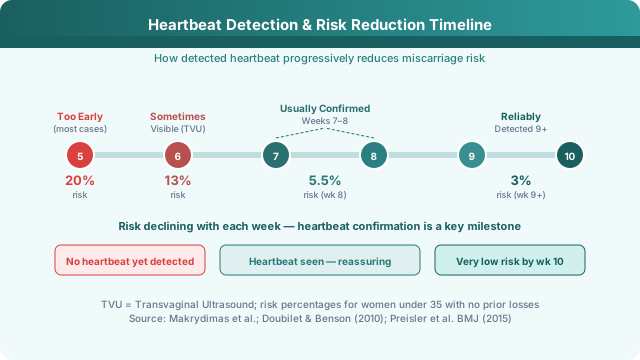
A fetal heartbeat first appears between 6 and 8 weeks of gestational age. Transvaginal ultrasound (TVU) can usually detect cardiac motion by week 6–6.5. Abdominal ultrasound (the standard transducer pressed against the abdomen) is less sensitive early and typically doesn't reliably detect cardiac activity until week 7–8.
If you have a scan at 5.5 weeks and no heartbeat is seen, this does not mean the pregnancy is failing; it may simply be too early. Most clinicians wait until at least 7 weeks (or ideally 8 weeks, when cardiac motion is reliably present) before drawing conclusions from the absence of a heartbeat.
The Risk Reduction Numbers
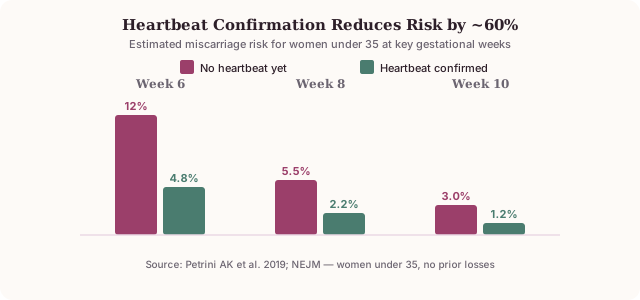
For women under 35 with no prior losses, here is how heartbeat confirmation changes the numbers at key gestational weeks:
| Gestational Week | No Heartbeat | Heartbeat Confirmed | Reduction |
|---|---|---|---|
| Week 6 | ~12% | ~4.8% | ~60% |
| Week 8 | ~5.5% | ~2.2% | ~60% |
| Week 10 | ~3.0% | ~1.2% | ~60% |
These figures come from Petrini AK et al. (2019) and are consistent with broader NEJM data on early pregnancy outcomes.
The reduction factor stays roughly constant across gestational weeks because the heartbeat's significance is about confirming embryonic development: specifically, that the cardiovascular system is functional. This is independent of how far along the pregnancy is.
Why Heartbeat Detection Matters Biologically
The majority of first-trimester miscarriages are caused by chromosomal abnormalities in the embryo (most commonly trisomies, an extra copy of a chromosome). These errors typically prevent normal development and cause the pregnancy to stop progressing before the embryo develops a heartbeat.
An embryo that has developed a functional heart has cleared a critical developmental checkpoint. It has undergone gastrulation, begun cardiovascular development, and established a circulatory system. While chromosomal abnormalities can still result in loss after cardiac activity begins, they do so at a much lower rate than before.
This is why the heartbeat functions as a biological filter: pregnancies that reach cardiac development have, on average, far better chromosomal integrity than the broader population of pregnancies at conception.
Age Still Matters After Heartbeat
The heartbeat factor cuts risk in half regardless of age, but older women start from a higher baseline. For a 40-year-old at week 8:
- Without heartbeat: ~11% risk (5.5% baseline × 2.0 age multiplier)
- With heartbeat confirmed: ~4.4% (reduced by ~60%)
For a 45-year-old:
- Without heartbeat: ~15.4% at week 8
- With heartbeat: ~6.2%
These are still meaningfully higher than the under-35 figures, but the heartbeat provides proportionally similar reassurance across all age groups. Use our miscarriage risk calculator to see how your specific combination of age, week, and heartbeat status combines.
What About the "Missed Miscarriage"?
A missed miscarriage (also called a silent miscarriage) is when the embryo stops developing but the body does not yet expel it. This is a specific concern because a heartbeat may have been present at a previous scan and then absent at a follow-up.
Missed miscarriages account for roughly 1–2% of recognized first-trimester pregnancies. They are more common in women over 35 and in pregnancies with chromosomal abnormalities. The technical definition requires two ultrasounds showing an embryo with no cardiac activity. A single scan is not sufficient to diagnose a missed miscarriage.
If you had a confirmed heartbeat and are now having bleeding or pain, contact your healthcare provider immediately. These symptoms warrant evaluation, but they do not automatically indicate loss. Early pregnancy symptoms and miscarriage warning signs covers what to watch for.
Prior Losses and Heartbeat Risk
For women with prior pregnancy losses, the heartbeat confirmation is especially meaningful. Prior loss history raises baseline risk, but the heartbeat reduction factor still applies on top of that elevated baseline.
A woman with two prior losses at week 8 (no heartbeat yet) faces roughly 10% risk (5.5% × 1.8 prior-loss multiplier). With a confirmed heartbeat, that drops to around 4%. The improvement is real and clinically significant.
Our guide on recurrent miscarriage covers what testing is available for women with multiple losses and what the prognosis looks like.
What "Low Risk" Actually Means
It is worth being precise about language here. "Low risk" after a heartbeat does not mean "no risk." A 2% risk at week 8 means that roughly 1 in 50 pregnancies at that stage will still end in loss. If you've already experienced a loss, that probability is not abstract.
What the data does show: the vast majority of pregnancies with confirmed cardiac activity at 6–10 weeks continue to delivery. In a population of 100 women at week 8 with a confirmed heartbeat and under-35 age and no prior losses, roughly 98 will have ongoing pregnancies.
For a personalized estimate combining your gestational week, age, heartbeat status, and loss history, use the miscarriage risk calculator. For ongoing anxiety about your pregnancy, our article on managing first-trimester anxiety may also be useful.
What "Vanishing Twin" Means for Your Risk
Vanishing twin syndrome (VTS) describes a pregnancy that begins as a twin or higher-order multiple but loses one embryo (usually in the first trimester) while the other continues to develop normally. It's one of the more confusing findings in early pregnancy because it's both a loss and a continuing pregnancy at the same time.
How often it happens. Before routine early ultrasound, VTS was largely undetectable and people assumed they had a singleton. Modern transvaginal scans at 6–9 weeks detect it far more often. Cohort studies estimate that 20–30% of twin pregnancies show vanishing twin before week 12. In IVF pregnancies with multiple embryo transfer, the rate is higher, with roughly 36% of initially confirmed twin gestations resolving into singletons.
How it's detected. Typically, a first scan around week 6–8 shows 2 gestational sacs, with or without heartbeats. A follow-up scan shows 1 sac with a healthy embryo and the other sac either empty, collapsed, or containing an embryo without cardiac activity. The "vanished" sac is often reabsorbed by the body within a few weeks and may leave no visible trace on later scans.
Impact on the surviving twin. For vanishing twin events in the first trimester, research consistently shows no increase in miscarriage risk for the surviving embryo, and no increase in preterm birth, low birth weight, or congenital anomalies. The surviving singleton's pregnancy proceeds with the same risk profile as any other singleton at that gestational week. A 2015 review in Human Reproduction Update pooled data from 14 studies and found that first-trimester VTS did not meaningfully affect the surviving fetus's outcomes.
When timing matters more. If the vanishing twin event occurs after 14 weeks (rarer), there's a modest increase in preterm birth and growth restriction risk for the survivor, and closer monitoring is recommended. First-trimester VTS doesn't carry these associations.
Bleeding and cramping. Around 1 in 4 people with VTS experience light bleeding or mild cramping when one twin is reabsorbed, which can be distressing because it mimics the symptoms of an impending full miscarriage. Ultrasound is the only reliable way to tell the difference. If you've been told you have a twin pregnancy and you're bleeding, ask for an early rescan rather than assuming the worst.
What the calculator shows. Our miscarriage risk calculator estimates risk for the pregnancy you currently have. If your scan now shows 1 healthy embryo with cardiac activity, the heartbeat reduction applies in full, regardless of whether the pregnancy started as twins.
Sources: Petrini AK et al. (2019). Fetal viability after ultrasound confirmation of heartbeat. AJOG. Nybo Andersen AM et al. (2000). BMJ. Cohain JS et al. (2017). EJOG. Pinborg A et al. (2005). Consequences of vanishing twins in IVF/ICSI pregnancies. Human Reproduction, 20(10):2821–2829. Evron E et al. (2015). Vanishing twin syndrome: a review. Human Reproduction Update, 21(3):258–271.