Managing Anxiety in the First Trimester: What Helps and What Doesn't
First-trimester anxiety is nearly universal, especially after prior loss. This guide covers what the evidence shows about managing pregnancy anxiety, from practical strategies to when to seek support.
Quick Answer
First-trimester anxiety is extremely common, especially after prior pregnancy loss. Evidence-based approaches include scheduled worry time, limiting symptom-checking, maintaining routine activity, and talking therapy or medication for persistent cases. Using a risk calculator can help about 1 in 3 people contextualize their worry; for the rest, a single reassurance scan at 7–8 weeks is more grounding.
First trimester anxiety is, for an estimated 30–40% of pregnant people, the defining experience of the early weeks. Instead of joy and anticipation, managing anxiety becomes the main daily task. Every twinge, every trip to the bathroom, every morning without nausea triggers a spiral. The rate is higher still for people who have previously lost a pregnancy.
Pregnancy-related anxiety is not a character flaw. It is a rational response to a situation where something important and fragile is happening, where you have very little control, and where uncertainty is unavoidable. What you can control is how you relate to that uncertainty.
How Common Is First-Trimester Anxiety?
Studies consistently find that 15–20% of pregnant women experience clinically significant anxiety, with rates highest in the first trimester and in women with prior pregnancy loss. Among women in "pregnancy after loss" (PAL) situations, rates of anxiety and PTSD-like symptoms can reach 30–40%.
This is not just emotional discomfort. Persistent high anxiety is associated with increased cortisol levels, which can affect sleep, appetite, and immune function. Managing anxiety during pregnancy is a genuine health priority, not a luxury.
What Helps: Evidence-Based Approaches
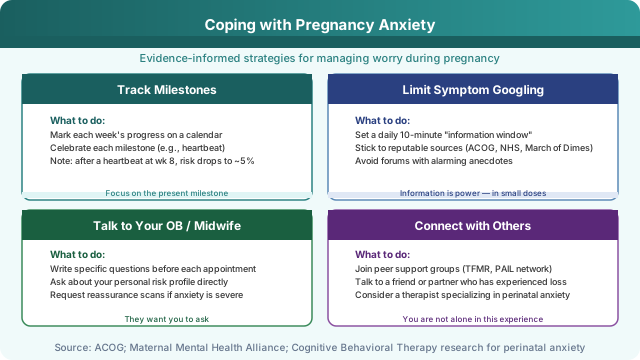
Limiting symptom-checking
"Body checking" (repeatedly examining your body for signs of miscarriage, including excessive googling, frequent self-testing, and searching for reassurance online) temporarily reduces anxiety but increases it over time. Each check teaches your nervous system that there is danger to monitor for. Limiting checks to clinically meaningful ones (e.g., one call to your provider if a specific symptom changes significantly) is more effective than seeking constant reassurance.
Scheduled worry time
A technique from cognitive behavioral therapy: designate 15–20 minutes per day as your "worry window." When anxiety-related thoughts arise outside that time, acknowledge them and defer them: "I'll think about this during my worry time." This reduces the all-day background hum of anxiety by containing it to a defined period. In CBT trials, about 40–50% of participants report meaningful anxiety reduction within 2 weeks.
Maintaining routine and activity
Physical activity during early pregnancy, unless specifically contraindicated by your provider, is safe and beneficial. Exercise is one of the most evidence-based interventions for anxiety in the general population, and this applies to pregnancy. A 30-minute walk does not require a medical consultation and has no documented risk in uncomplicated early pregnancy.
Talking therapy (CBT or mindfulness-based)
Cognitive behavioral therapy (CBT) has the strongest evidence base for anxiety across populations, including pregnancy. If you have access to a therapist familiar with perinatal anxiety, this is worth pursuing. Mindfulness-based interventions also have good evidence, and apps like Calm or Headspace require no referral. The goal is not to eliminate anxious thoughts but to change your relationship to them.
Medication when appropriate
If anxiety is severe (affecting sleep, eating, or functioning), medication may be appropriate. SSRIs (selective serotonin reuptake inhibitors) are the most studied antidepressants in pregnancy. The data does not show a meaningful increase in fetal risk with SSRI use in the first trimester for most agents, and untreated severe anxiety has its own risks. This is a conversation for your OB/GYN or psychiatrist, not a decision made based on a blog post.
Using Risk Data as a Grounding Tool
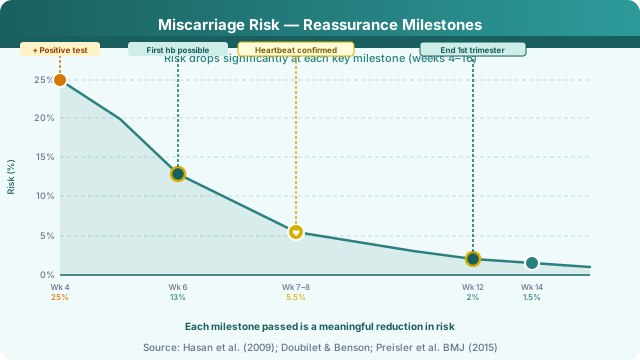
For roughly 1 in 3 people, knowing the actual numbers helps. Understanding that miscarriage risk at week 8 with a confirmed heartbeat is around 2–3% is more grounding than an abstract "most pregnancies are fine." Our miscarriage risk calculator provides that context: not to alarm, but to inform.
For the other 2 in 3, numbers make anxiety worse. If checking your risk estimate repeatedly becomes part of a checking pattern that elevates your anxiety, the tool is not helping you. In that case, limit yourself to one calculation per week maximum, or none at all.
Early Reassurance Scans
Most OB/GYNs will schedule an early viability scan at 7–8 weeks for women with anxiety or prior loss history. This ultrasound confirms a heartbeat and appropriate development. Seeing a beating heart on the screen is for most people the single most reassuring experience in early pregnancy because it replaces an estimate with actual evidence.
If your provider is not proactively offering this and you have a history of loss or significant anxiety, it is appropriate to ask for one. Most clinicians will accommodate this request.
Once a heartbeat is confirmed, your statistical risk drops significantly. Our article on miscarriage risk after heartbeat confirmation explains exactly how much.
Pregnancy After Loss: A Different Experience
People who have experienced prior pregnancy loss (whether miscarriage, stillbirth, or infant loss) often find that a new pregnancy reactivates grief rather than replacing it. This is normal. Pregnancy after loss is not a second chance to have the "normal" pregnancy experience; it is a new experience with its own emotional terrain.
4 support resources specific to pregnancy after loss:
- Tommy's (tommys.org): UK-based pregnancy loss charity with PAL resources
- RESOLVE (resolve.org): infertility and pregnancy loss support
- The Miscarriage Association: support for anyone affected by pregnancy loss
- Online PAL communities (Reddit's r/PregnancyAfterLoss has 60,000+ members)
Connection with others who have the same experience can reduce the isolation that feeds anxiety.
When Professional Support Is the Right Call
Consider seeking professional support if:
- Anxiety is affecting your sleep consistently
- You are avoiding medical appointments due to fear of bad news
- You are unable to experience any positive anticipation about the pregnancy
- You are having intrusive thoughts about harm to yourself or the pregnancy
- You have a history of anxiety, depression, or PTSD that is being reactivated
Your mental health in pregnancy affects your physical health, your relationship, and eventually your ability to be present for your child. Getting support is not a sign of weakness; it is appropriate self-care.
For more context about risk and the first trimester, our guide on managing first-trimester risk and our article on early pregnancy symptoms versus warning signs may provide additional grounding.
Apps and Tools That Help (and Ones That Don't)
Not every app marketed to pregnant people is useful. A few reduce anxiety, and a few amplify it. Here's a short, honest breakdown of 4 categories.
Mindfulness and meditation apps. Calm and Headspace both have pregnancy-specific guided tracks (typically 10–15 minutes). A 2018 meta-analysis of 8 mindfulness studies in pregnancy found moderate reductions in anxiety and depressive symptoms, with effects similar to brief in-person CBT. Insight Timer is free and has perinatal meditations contributed by therapists. Any of these is a reasonable starting point; pick whichever interface you'll actually open.
Pregnancy tracker apps, with caveats. Flo, Ovia, and What to Expect give you a weekly overview of fetal development. For around half of users these apps reduce anxiety by replacing vague uncertainty with a concrete timeline. For the other half, the daily "your baby is the size of..." notifications become a symptom-checking trigger. If you notice your anxiety spikes after opening the app, mute notifications and limit yourself to 1 check per week.
Peer support communities. Two stand out as well-moderated and evidence-informed. Tommy's (tommys.org) runs a UK-based pregnancy loss and PAL forum with moderators trained on current clinical guidance. Reddit's r/PregnancyAfterLoss has 60,000+ members and strict rules against medical speculation, which keeps the content grounded.
What to avoid. Symptom-checker websites that ask you to enter bleeding or pain descriptions and return a probability estimate. General Google searches for specific symptom combinations (the top results are almost always worst-case anecdotes). Forums that allow unmoderated medical advice between users. And Facebook groups with more than 10,000 members; moderation typically can't keep pace, and anxiety-amplifying content spreads faster than corrections.
A simple rule: if an app or forum leaves you calmer than when you opened it, keep it. If it leaves you more anxious more than twice, delete it. The 5 minutes spent uninstalling is one of the higher-return anxiety interventions available in pregnancy.
Sources: Faisal-Cury A, Menezes PR (2007). Prevalence of anxiety and depression during pregnancy. Revista Brasileira de Psiquiatria. Biaggi A et al. (2016). Identifying the women at risk of antenatal anxiety and depression. Journal of Affective Disorders. Tommy's National Centre for Miscarriage Research.