What Causes Miscarriage? A Plain-Language Medical Guide
Most miscarriages are caused by chromosomal errors, not by anything the pregnant person did. This guide covers all known causes, from the most common to the rare, with evidence-based explanations.
Quick Answer
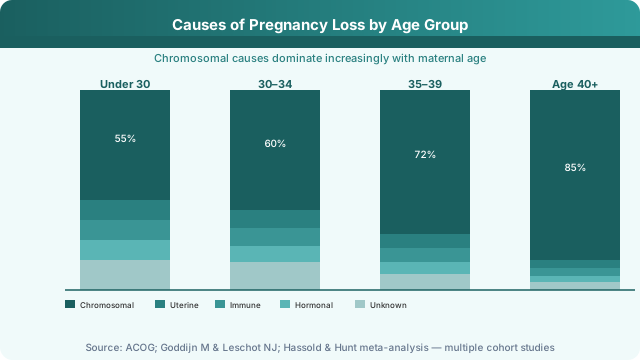
Most first-trimester miscarriages (roughly 50–70%) are caused by chromosomal abnormalities in the embryo. These are random genetic errors, not anything the pregnant person caused. Other causes include uterine structural issues, immune conditions, hormonal factors, and (rarely) infection. In roughly 50% of recurrent losses, no cause is ever identified.
What causes miscarriage is the first and most urgent question after a loss, and the honest answer is that most miscarriage causes are embryonic, not maternal. The medical explanation (usually phrased as "chromosomal abnormality") can feel both informative and deeply unsatisfying at the same time.
This guide covers all known causes of pregnancy loss, organized from most to least common and with clear context for what each cause means for future pregnancies.
The Most Common Cause: Chromosomal Abnormalities
The majority of first-trimester losses are caused by chromosomal abnormalities in the embryo: trisomies (extra chromosomes), monosomies (missing chromosomes), and structural rearrangements that prevent normal development.
These errors arise primarily during egg formation (meiosis) and become more frequent with maternal age. A 28-year-old produces roughly 20–25% chromosomally abnormal eggs; a 42-year-old produces roughly 70–80% abnormal eggs. This is why miscarriage risk rises so steeply with age.
These errors are random. They are not caused by:
- Physical activity, including exercise, sex, or lifting
- Stress or emotional state
- Prior contraceptive use
- Prior terminations
- Diet or nutrition (unless severe deficiency)
- Environmental exposures at typical background levels
A pregnancy lost to chromosomal abnormality is not a sign that something is wrong with the reproductive system or that future pregnancies will also be affected. Each new embryo is a new genetic combination.
Our detailed guide on chromosomal abnormalities and miscarriage covers the biology in more depth.
Uterine Structural Issues (~10–15% of Recurrent Losses)
4 anatomical variations can affect the uterine environment and increase miscarriage risk:
Uterine septum: A band of fibrous tissue dividing the uterine cavity. It can impair blood flow to an implanting embryo. Correction by hysteroscopic resection is associated with improved outcomes, though evidence from randomized controlled trials is limited.
Submucosal fibroids: Benign muscle tumors that protrude into the uterine cavity can interfere with implantation. Hysteroscopic removal is associated with improved fertility outcomes.
Asherman's syndrome: Intrauterine adhesions (scar tissue), often following uterine surgery, can reduce the surface area available for implantation.
Bicornuate or arcuate uterus: Shape variations of the uterus. The clinical significance is variable; most women with an arcuate uterus have normal pregnancies, while a bicornuate uterus is associated with a 2-3 fold higher second-trimester loss risk.

Antiphospholipid Syndrome (APS): The Most Important Treatable Cause
Antiphospholipid syndrome (APS) is an autoimmune condition affecting roughly 5–15% of women with recurrent pregnancy loss. The immune system produces antibodies (anticardiolipin, lupus anticoagulant, anti-beta2 glycoprotein I) that interfere with phospholipid-binding proteins, disrupting placental function and promoting thrombosis.
APS is significant because it is treatable. Low-dose aspirin combined with low-molecular-weight heparin (LMWH) during pregnancy reduces the miscarriage rate in women with APS from roughly 70–90% (without treatment) to around 25–30%. This is one of the most dramatic treatment effects seen in RPL management.
Testing requires two positive antibody results at least 12 weeks apart. A single positive result is insufficient for diagnosis because false positives are common.
Thyroid and Hormonal Factors
Hypothyroidism: Thyroid hormone affects endometrial development and implantation. Both overt hypothyroidism (elevated TSH, low free T4) and subclinical hypothyroidism (TSH 2.5–10 mIU/L with normal T4) have been associated with increased miscarriage risk. Most specialists target a TSH below 2.5 mIU/L in women with RPL.
Hyperthyroidism: Poorly controlled hyperthyroidism is also associated with adverse pregnancy outcomes. Careful management with the lowest effective dose of antithyroid medication is standard.
Progesterone: Progesterone supports the uterine lining (endometrium) after ovulation, preparing it for implantation and maintaining early pregnancy. Luteal phase deficiency (insufficient progesterone in the second half of the cycle) has been proposed as a cause of early loss, though the evidence is contested. Progesterone supplementation is often offered empirically in women with prior losses.
Uncontrolled diabetes: Women with uncontrolled preconception and early-pregnancy diabetes (high HbA1c) have elevated miscarriage rates. This is largely reversible with good glycemic control.
Inherited Thrombophilias: A Nuanced Picture
Inherited thrombophilias (genetic variants that increase blood clotting tendency) have been extensively studied as potential RPL causes. The most studied variants are factor V Leiden, prothrombin G20210A mutation, and MTHFR variants.
The evidence for their role in early miscarriage is weak and has been downgraded in recent guidelines. Most major guidelines (ACOG, ESHRE, RCOG) no longer recommend routine thrombophilia testing for women with first-trimester RPL. The exception is testing for antiphospholipid syndrome, which is an acquired (not inherited) thrombophilia and remains firmly in the standard workup.
Second-trimester losses and late pregnancy complications (severe pre-eclampsia, fetal growth restriction) have a stronger association with inherited thrombophilias than first-trimester miscarriage.
Rare Causes
Uterine or cervical infection: Specific infections (bacterial vaginosis, chlamydia, Listeria, and cytomegalovirus) can cause miscarriage when severe or untreated, but together account for less than 1% of first-trimester losses in women receiving prenatal care.
Cervical insufficiency: More relevant to second-trimester loss. The cervix begins to dilate without uterine contractions, leading to a pregnancy that is delivered too early. Signs include painless dilation in the second trimester. Treatment is cervical cerclage placement.
Toxin exposure at high doses: A small set of occupational exposures (ionizing radiation above 50 mSv, organic solvents like toluene and xylene, and heavy metals like lead and mercury) are associated with miscarriage. Everyday exposures, including coffee in moderate amounts (under 200 mg/day), are not.
What "Unexplained" RPL Means
Roughly 50% of RPL cases have no identifiable cause after complete workup. This is genuinely frustrating to hear. The honest explanation is that our tools for identifying miscarriage causes are imperfect, and a subset of biological causes are not yet understood.
The prognosis for unexplained RPL is still meaningful: 60–75% of couples with unexplained RPL achieve a live birth in a subsequent pregnancy without any specific treatment. Empirical progesterone is often offered and may provide modest benefit.
Use our miscarriage risk calculator to understand how your personal risk factors combine in a current pregnancy. For a focus on the RPL diagnostic workup, see our guide on recurrent miscarriage causes and testing.
What Doesn't Cause Miscarriage: Debunking Common Myths
After a loss, it's common to comb through the previous weeks looking for something you did wrong. Here's the honest list of things that do not cause miscarriage at ordinary levels of exposure. Most come from large cohort studies or systematic reviews with no detectable effect.
Exercise, including running and most gym routines. A 2022 meta-analysis of 13 studies found no increase in miscarriage risk with moderate exercise during early pregnancy, and ACOG recommends 150 minutes per week.
Sex during pregnancy. No link with miscarriage at any trimester in women without specific complications like placenta previa.
Lifting moderate weights. Lifting under 25 pounds occasionally, or under 15 pounds repeatedly, has no documented link with miscarriage. The concern is back strain, not pregnancy loss.
Prior contraceptive use. Hormonal contraception, IUDs removed before conception, and barrier methods have no effect on future miscarriage risk.
Prior terminations. A first-trimester abortion performed safely does not increase miscarriage risk in subsequent pregnancies. Multiple surgical procedures carry a small risk of cervical damage, but this is uncommon.
Stress and emotional upset. Despite decades of claims, high-quality studies have not shown that day-to-day stress, grief, or an argument caused a miscarriage. Severe, sustained trauma may have a small effect, but ordinary life stress does not.
Hot baths within reason. Core body temperature above 102°F (38.9°C) for extended periods is the theoretical concern. Short baths in water under 100°F (37.8°C) are considered safe.
Most foods within standard guidelines. Pasteurized dairy, well-cooked meats, and most cheeses are safe. The actual food-borne risks are Listeria from soft unpasteurized cheeses and Toxoplasma from undercooked meat.
Air travel. No link with miscarriage has been shown on commercial flights. Airline policies about travel after 36 weeks relate to labor risk, not miscarriage.
Working at a computer. Radiation from monitors and laptops is not linked to miscarriage. Long sedentary hours are a circulation concern, not a loss concern.
If one of these was weighing on your mind, you can set it down.
Sources: ACOG Practice Bulletin No. 200: Early Pregnancy Loss (2018). Regan L et al. (1989). Prospective study of spontaneous abortion. BMJ. Rai R, Regan L. (2006). Recurrent miscarriage. Lancet. Brosens I et al. (2011). Uterine junctional zone. Human Reproduction Update.