Chromosomal Abnormalities and Miscarriage: The Most Common Cause
Chromosomal abnormalities cause 50–70% of first-trimester miscarriages. This guide explains what goes wrong, why it happens more often with age, and what it means for future pregnancies.
Quick Answer
Chromosomal abnormalities (most commonly trisomies caused by errors during egg formation) account for 50–70% of first-trimester miscarriages. These errors are largely random, increase with maternal age, and are not caused by anything the pregnant person did or didn't do. A chromosomally abnormal pregnancy loss is not a sign that future pregnancies will also be affected.
Chromosomal abnormalities are the leading cause of miscarriage in the first trimester, accounting for 50–70% of losses. For anyone asking "why?" after a miscarriage, the honest answer is usually an embryo with the wrong number of chromosomes. Understanding what this means biologically can explain what happened and what it signals about future pregnancies.
What Is Chromosomal Aneuploidy?
Humans normally have 46 chromosomes, arranged in 23 pairs. One copy of each pair comes from the egg; one from the sperm. An embryo is considered euploid if it has the correct number of chromosomes (46 total, 23 pairs).
Aneuploidy means the wrong number of chromosomes: most often one extra (trisomy, 47 chromosomes total) or one missing (monosomy, 45 chromosomes). The most familiar trisomy is trisomy 21, which causes Down syndrome. Most trisomies, however, are incompatible with survival and cause very early pregnancy loss, often before the person even knows they are pregnant.
How Chromosomal Errors Happen
The most common cause of trisomy in early miscarriage is a meiotic error during egg formation. Meiosis is the specialized cell division that creates eggs and sperm. It requires a chromosome to split and separate correctly into daughter cells. When chromosomes fail to separate properly (a process called non-disjunction), one daughter cell gets both copies of a chromosome pair and the other gets none.
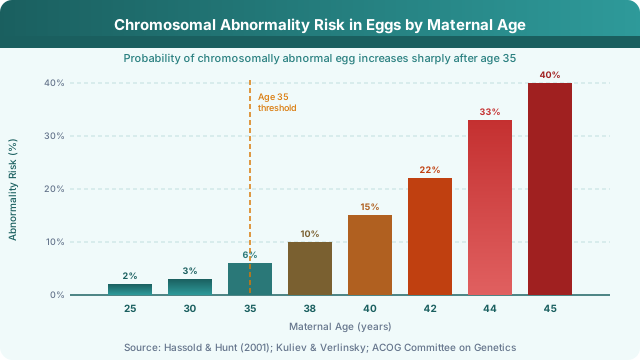
This error is much more common in eggs than in sperm, and much more common in older eggs. This is the primary reason maternal age is such a strong risk factor for both miscarriage and chromosomal conditions in live births.
Which Chromosomal Abnormalities Are Most Common in Miscarriage?
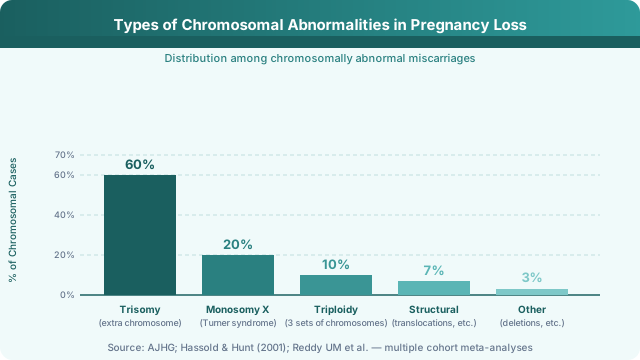
Analysis of products of conception (POC) from miscarriages has identified the distribution of chromosomal abnormalities:
Autosomal trisomies (~50–55% of all chromosomally abnormal losses)
The most common category. The most frequent specific trisomies found in miscarriage tissue are trisomy 16 (the most common chromosomal finding in spontaneous abortion), trisomy 22, trisomy 21, trisomy 15, and trisomy 13/18. Trisomy 16 is almost always incompatible with life; trisomy 21 sometimes results in a surviving fetus with Down syndrome, but most trisomy-21 pregnancies are also lost.
Monosomy X (~10–15%)
Turner syndrome (45,X, with one X chromosome and no second sex chromosome) is common in miscarriage but rarely survives to birth. Only about 1% of 45,X conceptuses survive to term; the rest are lost in the first or second trimester.
Polyploidy (~10–15%)
Triploidy (69 chromosomes, three of every pair) and tetraploidy (92 chromosomes) are non-viable and result in miscarriage, often with a complete or partial molar pregnancy.
Structural abnormalities (~5%)
Deletions, duplications, or rearrangements that disrupt critical gene dosage.
Is This the Parent's Fault?
No. Chromosomal errors in early embryos are random events. They are not caused by physical activity, diet, stress, prior contraceptive use, prior termination, environmental exposure at normal levels, or anything else within a person's control.
The framing matters: a miscarriage caused by chromosomal aneuploidy is not a "failed" pregnancy. It is a pregnancy where the embryo's genetic blueprint had an error that made development impossible. The body recognized this and ended the pregnancy. This is a normal biological filtering process, not a failure of the reproductive system.
What Chromosomal Testing of Pregnancy Tissue Shows
When products of conception are available after a miscarriage, chromosomal testing can determine whether a chromosomal abnormality was the cause. Two methods are used:
Conventional karyotyping: The gold standard historically, but has a culture failure rate of 15–25% (cells fail to grow) and misses small abnormalities.
Chromosomal microarray (CMA): A newer technique that analyzes DNA directly from tissue without cell culture. It identifies chromosomal abnormalities across the entire genome and has a much lower failure rate. ACOG recommends CMA as the preferred method when POC testing is performed.
Knowing that a loss was chromosomally abnormal can provide a measure of closure: it means the loss was likely a random event, not a sign of a structural problem with the uterus or a maternal condition that needs treatment.
What It Means for Future Pregnancies
A single chromosomally abnormal miscarriage is generally not a sign that future pregnancies will also be affected. Each embryo is a new genetic combination. A 30-year-old who loses a pregnancy to trisomy 16 faces roughly the same risk in a subsequent pregnancy as a 30-year-old who has never miscarried.
The exception: if the same chromosomal abnormality recurs in multiple losses, this may point to a parental translocation (a balanced rearrangement in one parent's chromosomes) rather than random error. Parental karyotyping can identify this. It affects roughly 2–5% of couples with recurrent pregnancy loss.
For older women, repeated chromosomally abnormal losses are less likely to be due to a parental translocation and more likely to reflect age-related egg quality decline. In this population, IVF with preimplantation genetic testing for aneuploidy (PGT-A) is worth discussing with a reproductive endocrinologist.
Testing Doesn't Change the Outcome, But It Changes the Understanding
Chromosomal testing of pregnancy tissue doesn't change what happened or prevent future losses. What it does is provide information: specifically, whether the loss was likely random (chromosomal) or potentially recurrent (non-chromosomal). That information shapes subsequent clinical management and can provide a partial sense of resolution.
Use our miscarriage risk calculator to understand how your current risk compares to population norms based on your age, gestational week, and history. For a broader view of what causes pregnancy loss beyond chromosomal factors, our guide on recurrent miscarriage causes covers the full spectrum of investigation.
PGT-A and Chromosomal Screening Options
Preimplantation Genetic Testing for Aneuploidy (PGT-A) is an add-on to IVF that screens embryos for chromosomal errors before transfer. It's the only current technology that can filter chromosomally abnormal embryos out of the reproductive path rather than detecting them after conception.
How it works. During an IVF cycle, embryos are grown to the blastocyst stage (day 5 or 6). A few cells are biopsied from the trophectoderm (the outer layer that will become the placenta, not the inner cell mass that becomes the fetus). Those cells are sent for next-generation sequencing, which counts chromosomes. Only embryos confirmed as euploid (46 chromosomes, 23 pairs) are transferred in a later cycle.
Who's offered PGT-A. ASRM considers PGT-A appropriate for couples with recurrent pregnancy loss, advanced maternal age (35 or older), recurrent IVF failure, or a known parental chromosomal rearrangement. It's not routinely recommended for younger couples with no fertility history, because the modest benefit doesn't outweigh the risk of harming a viable embryo during biopsy.
Success rates. Per-transfer live birth rates with euploid embryos are roughly 55–65% across age groups, vs 40–50% in unscreened transfers for women 35–37 and 15–25% for women 40 and above. The miscarriage rate after euploid transfer falls to about 8–10%, compared to 20–30% without screening in older women. The cumulative per-cycle pregnancy rate, though, isn't always higher; roughly 1 in 3 cycles in women over 40 yield no euploid embryos at all, the benefit is concentrated in per-transfer outcomes rather than per-egg-retrieval outcomes.
Costs at a high level. PGT-A typically adds $3,000–$7,000 to a standard IVF cycle in the U.S., on top of the $12,000–$20,000 base cost of IVF. Insurance coverage is uneven: 21 U.S. states mandate at least partial IVF coverage, but PGT-A is often excluded.
What PGT-A can't do. It doesn't detect single-gene disorders (that's PGT-M), structural rearrangements (PGT-SR), or mosaicism with full confidence. It also doesn't change the underlying egg-quality problem; it filters rather than fixes. For women whose cohort of eggs is mostly aneuploid, PGT-A can reveal that no transferable embryos exist, which is painful information but helps avoid repeated failed transfers.
Discuss PGT-A with a reproductive endocrinologist, not a general OB/GYN. The decision depends on age, prior loss history, and financial and emotional capacity for IVF.
Sources: Hassold T, Hunt P (2001). To err (meiotically) is human: the genesis of human aneuploidy. Nature Reviews Genetics. Philipp T et al. (2003). Embryoscopic and cytogenetic analysis of 233 missed abortions. Human Reproduction. ACOG Practice Bulletin No. 200 (2018). American Society for Reproductive Medicine (ASRM) Practice Committee. ASRM Committee Opinion (2018). The use of preimplantation genetic testing for aneuploidy (PGT-A): a committee opinion. Fertility and Sterility, 109(3):429–436. ESHRE PGT Consortium data collection (2020).