Miscarriage Risk by Week: A Data-Driven Breakdown
See exactly how miscarriage risk changes from week 4 through week 16, with figures drawn from large obstetric cohort studies and explained in plain language.
Quick Answer
Miscarriage risk starts at roughly 22–25% at week 4 and falls steeply through the first trimester, reaching about 3% by week 10 for women under 35 with a confirmed heartbeat. Each week of a healthy pregnancy is genuinely meaningful.
The question "what are my chances this week?" is one of the most searched things in early pregnancy, and for good reason. Most sources give you a single number like "1 in 5 pregnancies end in miscarriage," which tells you almost nothing about your odds right now. The miscarriage risk by week tells a more useful story.
This article breaks down the numbers week by week using figures from published obstetric cohort studies. All statistics are for women under 35 with no prior pregnancy losses, unless stated otherwise.
Why Risk Isn't Flat Across the Trimester
Most people think of the first trimester as uniformly risky, but the risk curve is steep and front-loaded. The majority of pregnancy losses happen in the first 6 weeks after conception (weeks 6–8 by gestational age). By week 10, around 75% of all first-trimester losses have already occurred.
The biology explains this. Early embryos are in rapid chromosomal division. Errors during this process (a missing chromosome, an extra one, a structural rearrangement) are far more likely to be lethal in the first weeks than later. Once an embryo clears these early milestones and cardiac activity begins, the underlying biology becomes more stable.
Week-by-Week Risk Estimates
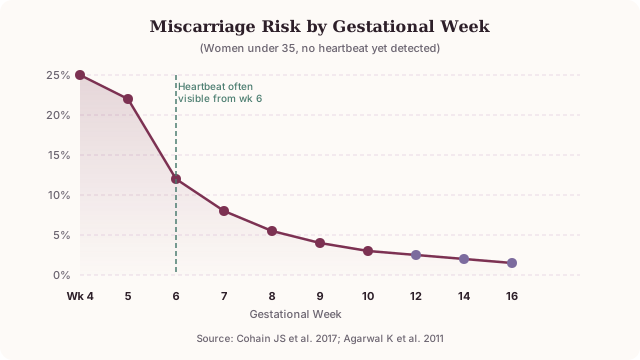
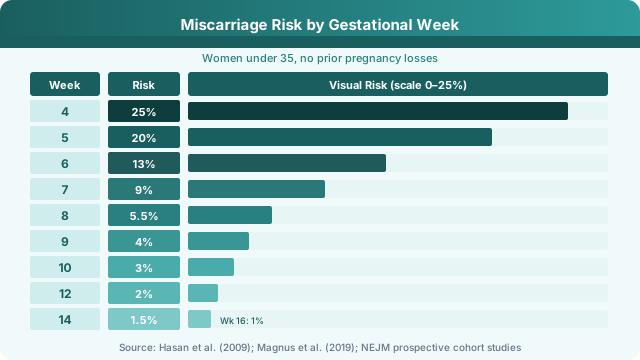
Here are the approximate miscarriage risk figures for each gestational week for women under 35 with no prior losses. These draw from Cohain JS et al. (2017) and Agarwal K et al. (2011).
Week 4: ~25%
This is the week most people get a positive pregnancy test. Risk is highest here, partly because the figure includes "chemical pregnancies" (very early losses that resolve before symptoms appear). An estimated 30–50% of all conceptions are lost in this window, often before a missed period.
Week 5: ~20–22%
Risk remains high as the embryo implants and the placenta begins to form. hCG levels are rising rapidly but the pregnancy is not yet visible on ultrasound.
Week 6: ~12–14%
A meaningful drop. By week 6, a gestational sac and often a yolk sac are visible on transvaginal ultrasound. A fetal heartbeat may first be detectable this week, though it's not always visible yet.
Week 7: ~8–10%
Cardiac activity becomes reliably visible via transvaginal ultrasound. If a heartbeat is confirmed at week 7, your risk drops substantially to around 3.5–4.5% for women under 35.
Week 8: ~5–7%
By week 8, embryonic development has passed three critical milestones: the heart now has four functioning chambers, the neural tube has closed, and the embryo has grown from 2 mm to roughly 16 mm in crown-rump length. Risk without a confirmed heartbeat is around 5–7%; with a confirmed heartbeat, closer to 2–3%.
Week 9: ~3.5–5%
The embryo is now technically a fetus. Most major organ systems are present, though immature. Risk continues to fall.
Week 10: ~2.5–4%
This is often when the first prenatal appointment happens. If you've reached week 10 with a viable heartbeat, your risk has dropped to around 2.5–3% without additional risk factors.
Week 12: ~1.5–2.5%
The end of the first trimester. Risk drops to under 2% for most women under 35 with a confirmed heartbeat. This is the most common point at which couples announce a pregnancy publicly, because the residual risk is roughly 1 in 50.
Weeks 14–16: ~1–1.5%
Second-trimester losses are rare and increasingly driven by structural or placental issues rather than chromosomal abnormalities. Risk is now well below 2%.
What Changes These Numbers
These figures are baselines. Three factors shift them meaningfully:
Maternal age raises risk at every week. A 40-year-old at week 8 faces roughly twice the risk of a 28-year-old at the same week. Our guide on maternal age and miscarriage risk covers this in detail.
Heartbeat confirmation cuts risk roughly in half at any given week. A confirmed heartbeat at week 8 is one of the strongest positive signs in early pregnancy. You can read more in our piece on miscarriage risk after heartbeat confirmation.
Prior pregnancy losses raise risk by 30–130% depending on prior loss count. One prior loss applies a 1.3× multiplier, two prior losses 1.8×, and three or more applies 2.3×. Even at 2.3×, the absolute risk after a confirmed heartbeat at week 8 remains under 7%.
You can combine all four factors (week, age, heartbeat, prior losses) using our miscarriage risk calculator to get a personalized estimate.
When the Numbers Plateau
By week 16, the week-by-week decline essentially levels off. From week 16 to term, loss rates are very low and driven by different mechanisms (placental insufficiency, cord accidents, structural abnormalities) than the chromosomal losses common in the first trimester.
This shift is why ACOG defines two clinical categories: "early pregnancy loss" (before 13 weeks) and "late pregnancy loss" (after 20 weeks). The biology, causes, and clinical management differ substantially between these periods.
How the Calculator Combines These Numbers
The figures above are the foundation, but they don't tell you what your personal risk is. A 28-year-old with a confirmed heartbeat at week 9 has very different odds than a 41-year-old with no heartbeat yet at week 7, even though both are "first-trimester pregnancies."
Our calculator uses a layered model:
- Baseline risk by week comes from Cohain JS et al. (2017), the population average for women under 35 with no prior losses.
- Age multiplier comes from Nybo Andersen AM et al. (BMJ, 2000), the 634,000-pregnancy Danish cohort. Multipliers: 1.0× under 35, 1.4× for ages 35–39, 2.0× for 40–44, and 2.8× for 45+.
- Heartbeat factor is applied as a 0.4× reduction once cardiac activity is confirmed, drawn from Tong S et al. (2008) and ultrasound registry data.
- Prior loss multiplier is from Brigham SA et al. (1999): 1.3× after one loss, 1.8× after two, 2.3× after three or more.
The four factors combine multiplicatively, then are capped at clinically reasonable upper bounds. The result is a single percentage that reflects your specific situation rather than a population average.
Common Misconceptions About Week-Specific Risk
A few quick clarifications, because these come up constantly:
"The risk drops to zero after week 12." No. Risk drops to under 2% for most women, but it's never zero. Second-trimester losses are uncommon (1–2% of recognized pregnancies) but they do happen.
"If I had spotting, my risk doubles." No. Spotting alone doesn't change underlying risk if a heartbeat remains confirmed on ultrasound. About 25–30% of women have first-trimester spotting and most pregnancies continue normally.
"The 12-week scan changes everything." It changes more than nothing. A normal 12-week scan with appropriate fetal development confirms that you're past the highest-risk window, but the measurable drop happens earlier. Most of the chromosomal losses have already self-resolved by week 10.
How to Use This Information
These numbers can feel either reassuring or alarming depending on where you are in your pregnancy. A few grounding points:
- Risk at any individual week doesn't predict your outcome. These are population-level probabilities.
- Each additional week of a visible, healthy heartbeat is genuinely meaningful data. The descending curve is real.
- If you're monitoring a pregnancy closely after a prior loss, these figures give you a framework for understanding what each milestone means.
For a personal risk estimate combining all your factors, use our free miscarriage risk calculator. If you have ongoing concerns, your OB/GYN or midwife is the right resource for your specific situation.
Sources: Cohain JS et al. (2017). Spontaneous first trimester miscarriage rates. EJOG. Agarwal K et al. (2011). Miscarriage risk assessment. Br J Obstet Gynaecol. Nybo Andersen AM et al. (2000). Maternal age and fetal loss. BMJ.