How Maternal Age Affects Miscarriage Risk at Every Stage
Maternal age is the strongest modifiable predictor of miscarriage risk. This guide explains the age multipliers from a landmark 634,000-pregnancy study and what they mean practically.
Quick Answer
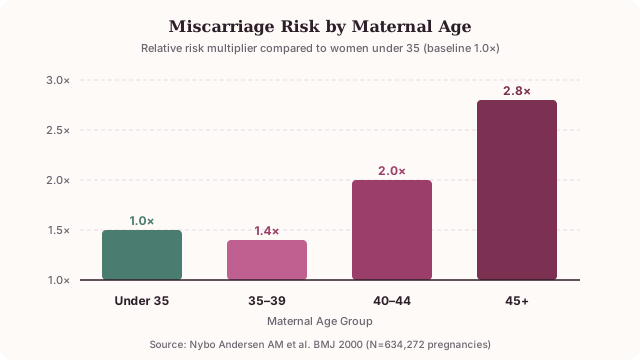
Compared to women under 35, miscarriage risk is approximately 1.4× higher at ages 35–39, 2.0× higher at 40–44, and 2.8× higher at 45 and older. These multipliers apply at every gestational week and come from a Danish cohort study of over 634,000 pregnancies.
Maternal age is the strongest single predictor of miscarriage risk, operating continuously rather than flipping at age 35. The risk at 36 is modestly higher than at 34, and the risk at 44 is roughly 2× higher than at 40. Understanding these gradients helps put any specific risk estimate in context.
This article explains the mechanism behind age-related risk, the research behind the specific multipliers used in our calculator, and what older mothers can do with this information.
The Biology: Why Age Raises Risk
The explanation starts with eggs. Women are born with all the eggs they will ever have (roughly 1–2 million at birth, declining to around 300,000 by puberty), continuing to fall throughout reproductive years. Unlike sperm, which are produced continuously throughout life, eggs age along with their owner.
As eggs age, the spindles and proteins responsible for correct chromosomal separation during fertilization become less reliable. When an egg is fertilized and the resulting embryo divides, chromosomes can fail to segregate correctly. The most common result is a trisomy: an embryo with three copies of a chromosome instead of two. Trisomies are typically incompatible with life and result in early miscarriage.
This is why chromosomal abnormalities are found in roughly 50–60% of all first-trimester miscarriages in women under 35, and in 70–80% of first-trimester miscarriages in women over 40.
The Research: Nybo Andersen et al. (2000)
The age multipliers used in our calculator come from a landmark epidemiological study published in the BMJ by Nybo Andersen AM et al. in 2000. The researchers analyzed data from 634,272 pregnancies in Denmark, making it one of the largest studies of spontaneous abortion ever conducted.
Their findings on relative risk by age group, compared to women aged 25–29:
- Under 30: approximately baseline (1.0×)
- 30–34: slight increase (~1.1–1.2×), clinically modest
- 35–39: 1.4× the baseline risk
- 40–44: 2.0× the baseline risk
- 45 and older: 2.8× the baseline risk
These multipliers apply independently of gestational week. A 40-year-old at week 8 faces approximately 2.0× the risk of a 28-year-old at week 8. The same relationship holds at week 5 or week 12.
What These Numbers Mean in Practice
Let me work through specific examples using our miscarriage risk calculator as a reference.
Week 8, no heartbeat, no prior losses:
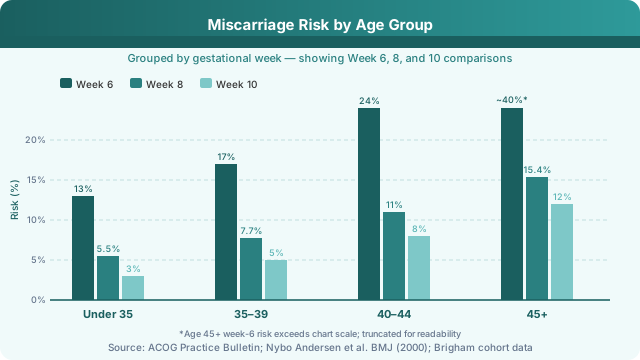
- Age 28: ~5.5% risk
- Age 37: ~7.7% (5.5% × 1.4)
- Age 42: ~11.0% (5.5% × 2.0)
- Age 46: ~15.4% (5.5% × 2.8)
Week 8, heartbeat confirmed, no prior losses:
- Age 28: ~2.2%
- Age 37: ~3.1%
- Age 42: ~4.4%
- Age 46: ~6.2%
As you can see, a confirmed heartbeat provides meaningful reassurance even at older ages. A 42-year-old with a confirmed heartbeat at week 8 faces roughly the same risk as a 28-year-old without a heartbeat at the same week.
Advanced Maternal Age: A Clinical Term Worth Understanding
"Advanced maternal age" (AMA) is the clinical term for pregnancy at 35 or older. It carries increased monitoring recommendations, not because 35 is a cliff edge, but because it is the point where age-related risks, including but not limited to miscarriage, begin to accumulate meaningfully.
At AMA, OB/GYNs typically recommend:
- First-trimester combined screening (nuchal translucency ultrasound + blood tests)
- Cell-free fetal DNA (cfDNA) testing, also called non-invasive prenatal testing (NIPT), which screens for chromosomal abnormalities from 10 weeks
- Closer monitoring of early pregnancy with more frequent viability scans
- Discussion of diagnostic testing (CVS or amniocentesis) if screening results are abnormal
None of these interventions change the probability of miscarriage, but they provide information that helps with decision-making. If NIPT detects a high likelihood of trisomy 21 (Down syndrome), for example, the couple can prepare accordingly. If results are normal, risk estimates shift meaningfully downward.
The Egg Quality vs. Egg Count Distinction
A common misconception is that declining fertility at older ages is about running out of eggs. In terms of miscarriage, the issue is egg quality: specifically, the chromosomal integrity of the eggs that are ovulated.
This is why IVF with preimplantation genetic testing (PGT-A) can help older women: embryos are tested for chromosomal abnormalities before transfer, selecting only euploid (chromosomally normal) embryos. Live birth rates per embryo transfer using PGT-A-tested euploid embryos are substantially higher than in cycles without testing, and miscarriage rates are lower, because the chromosomal filter has been applied before transfer.
For couples dealing with recurrent loss, especially at older maternal ages, PGT-A is worth discussing with a reproductive endocrinologist. Our article on recurrent miscarriage covers the full workup in more detail.
Reassurance: Most Older Mothers Have Healthy Pregnancies
It is easy to focus on multipliers and forget what they are multiplying. A 42-year-old at week 10 with a confirmed heartbeat and no prior losses faces roughly 2.4–3.6% risk, which still means 96–97.6% of pregnancies at that stage continue to delivery.
Most pregnancies in women 35–44 are successful. The increased monitoring recommended at AMA exists precisely because the vast majority of those pregnancies will proceed to a healthy birth, and early detection of the minority that won't improves outcomes for everyone.
Use the miscarriage risk calculator to see your own age-adjusted estimate combined with your gestational week, heartbeat status, and history. Then bring those numbers to your OB/GYN appointment for context.
Modifiable vs. Non-Modifiable Age-Related Risk Factors
Age itself can't be changed, and egg chromosomal quality is tied directly to age. But 5 adjacent factors that also rise with age can be influenced, and addressing them can lower the parts of miscarriage risk that aren't strictly genetic.
What you can't change:
- Egg quality and aneuploidy rate. The rate of chromosomally abnormal eggs climbs from roughly 20% at age 25 to about 40% at 35, 70% at 40, and over 80% at 45. No supplement, diet, or lifestyle change has been shown in randomized trials to reverse this curve.
- Ovarian reserve. The number of remaining eggs declines continuously from puberty onward.
- The age multiplier itself. Nybo Andersen's 1.4× / 2.0× / 2.8× figures hold regardless of overall health.
What you can change:
- BMI. A pre-pregnancy BMI of 30 or above raises miscarriage risk by roughly 1.2–1.3× on top of the age multiplier, based on data from the 2019 NICHD Maternal-Fetal Medicine Units Network. Reaching a BMI in the 18.5–24.9 range before conception removes that layer.
- Glycemic control. Women with pre-pregnancy HbA1c above 6.5% face a 2–4× higher first-trimester loss rate than women at 5.0–5.9%, per ACOG guidance on pregestational diabetes. Getting HbA1c under 6.5% (ideally under 6.0%) before conception is one of the highest-impact changes available.
- Folate status. Starting a prenatal vitamin with at least 400 mcg of folic acid 1–3 months before conception reduces neural tube defects and lowers early-loss rates in folate-deficient populations.
- Smoking, alcohol, and high-dose caffeine. Smoking raises miscarriage risk by about 1.2×. Heavy alcohol use raises it more. Caffeine above 300 mg per day (roughly 3 cups of coffee) has a modest association with loss in 2 large cohort studies.
- Thyroid function. TSH above 2.5 mIU/L in early pregnancy is associated with a 60% higher miscarriage rate in women with thyroid autoimmunity. TSH is a simple blood test and treatable with levothyroxine if needed.
Information, not prevention: NIPT, first-trimester screening, and early viability scans don't reduce miscarriage risk; they detect the chromosomal problems that cause a portion of it. For an older mother, though, that information matters: it can shift decision-making, reduce uncertainty, and allow earlier planning if results are abnormal.
The practical takeaway: at 38 or 42, you can't bring your baseline risk back to a 28-year-old's number. But by addressing BMI, blood sugar, folate, thyroid, and smoking, you can make sure your actual risk matches the age-only estimate rather than sitting above it.
Sources: Nybo Andersen AM et al. (2000). Maternal age and fetal loss. BMJ, 320:1708. Hassold T, Hunt P. (2001). To err (meiotically) is human. Nature Reviews Genetics. ACOG Practice Bulletin on Advanced Maternal Age. ACOG Practice Bulletin No. 201 (2018): Pregestational Diabetes Mellitus. Negro R et al. (2010). Increased pregnancy loss rate in thyroid antibody negative women with TSH levels between 2.5 and 5.0. J Clin Endocrinol Metab.