Trying Again After a Miscarriage: Timing, Risk Factors, and What to Expect
Most couples can try again after one cycle following a miscarriage. This guide covers optimal timing, how prior loss affects future risk, and what to expect emotionally and clinically in a subsequent pregnancy.
Quick Answer
Most clinicians and ACOG guidelines no longer recommend waiting more than one menstrual cycle before trying again after an early miscarriage. Physically, ovulation often returns within 2–4 weeks. The risk of miscarriage in a subsequent pregnancy after one loss is modestly elevated (about 1.3× baseline), but most couples who conceive after a loss go on to have a healthy pregnancy.
Trying again after miscarriage is a question that usually appears quickly, even when it arrives alongside grief. This isn't impatience; it's biology, hope, and the very human desire to move forward. Pregnancy after loss comes with its own clinical considerations and its own emotional texture, and both deserve honest information.
This article covers what the research says about timing, how a prior loss affects your odds in the next pregnancy, and what to expect clinically and emotionally.
How Quickly Does the Body Recover?
Physically, recovery from an early miscarriage (before 12 weeks) is typically swift. The uterus sheds its lining as it would during a menstrual cycle, and ovulation usually resumes within 2–6 weeks. Your first period typically returns 4–6 weeks after a completed miscarriage.
For a miscarriage managed medically (misoprostol) or surgically (uterine evacuation/ERPC), timing is similar. The uterine lining typically recovers fully within one cycle, though it varies based on gestational age and method.
A second-trimester loss, stillbirth, or losses requiring multiple interventions may involve longer physical recovery, and these situations warrant specific guidance from your provider rather than general timelines.
How Long Should You Wait?
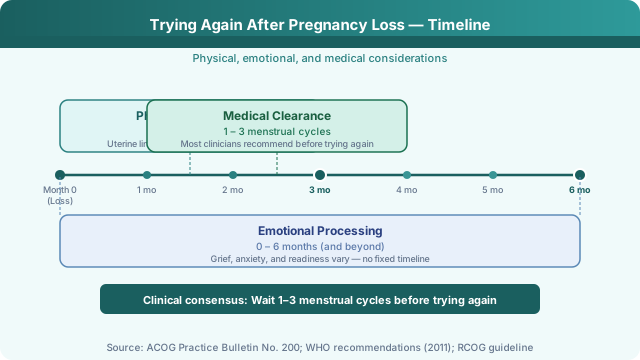
For decades, the standard advice was to "wait three months" before trying again. This recommendation was based on the idea that waiting for regular cycles would help date a new pregnancy accurately and allow the uterus to recover.
More recent evidence does not support mandatory waiting. A large WHO study of over 36,000 women (Bhattacharya S et al., 2010) found that women who conceived within 6 months of a miscarriage had better outcomes (higher live birth rates and lower complication rates) than those who waited longer, even after controlling for confounders.
ACOG updated its guidance based on evidence like this and now states that there is no medical reason to delay trying to conceive after an early miscarriage. One menstrual cycle is often recommended simply for dating purposes, not for clinical necessity.
The decision about timing is ultimately personal. Physical readiness is one factor; emotional readiness is another. Roughly 1 in 3 couples feels ready within a month, while others need 6 months or more to process the loss before engaging with another pregnancy emotionally. Both timelines are valid.
How Does One Prior Miscarriage Affect Future Risk?
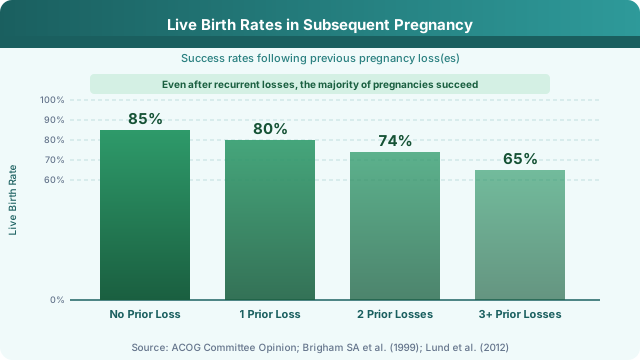
One miscarriage modestly elevates risk in a subsequent pregnancy. Based on Brigham SA et al. (1999), the multiplier is approximately 1.3× the baseline for your age and gestational week. For a 30-year-old at week 8 with no heartbeat, that increases risk from about 5.5% to roughly 7.2%.
That 1.3× multiplier sounds small, but context matters: it is much smaller than the age multiplier or the heartbeat factor. A 30-year-old with one prior loss at week 8 with a confirmed heartbeat faces roughly 2.8% risk, about the same as a 28-year-old without any prior loss at the same week without a heartbeat.
Prior loss is a risk factor, not a destiny. The miscarriage risk calculator combines your prior loss history with your current gestational week, age, and heartbeat status to give you an accurate combined estimate.
Getting Pregnant After Miscarriage: What to Expect
A few practical points for a subsequent pregnancy:
Confirming intrauterine location early
After a prior loss, most OB/GYNs will confirm an intrauterine pregnancy (and not an ectopic one) earlier than they might for a first pregnancy. This usually means an early ultrasound at 6–7 weeks rather than waiting until the standard 10–12 week appointment.
More frequent early monitoring
Most providers offer additional early scans or serial hCG measurements for women with prior losses. There's no single standard protocol, but it's reasonable to ask for more frequent monitoring if your anxiety is high.
Progesterone supplementation
Some providers prescribe vaginal progesterone (typically starting as soon as the pregnancy is confirmed) for women with prior losses. The evidence is mixed for women with one prior loss. The PRISM trial (2019) found a modest benefit (roughly a 5 percentage-point improvement in live birth rates) for women with three or more prior losses who also had early pregnancy bleeding. For one prior loss without bleeding, the evidence is less clear, but the treatment is low-risk.
Cervical length monitoring
If your prior loss was in the second trimester and involved premature cervical dilation (incompetent cervix), your provider will likely monitor cervical length via ultrasound beginning around 16 weeks and may recommend a cervical cerclage (a suture to reinforce the cervix).
The Emotional Reality of Pregnancy After Loss
Most people expect that a positive test after loss will feel celebratory. For about 2 in 3, it doesn't, at least not right away. Instead, they describe a state of hypervigilance, conditional hope, and ongoing grief alongside cautious optimism. This is known in the support community as "pregnancy after loss" (PAL), and it's its own distinct experience.
The emotional work of PAL involves:
- Holding uncertainty without being consumed by it
- Allowing attachment to develop gradually, rather than waiting for a "safe" point that may never arrive
- Grieving the lost pregnancy even while carrying a new one
- Accessing support from partners, from providers, from peer communities
Online spaces like r/PregnancyAfterLoss (Reddit, 60,000+ members) and Tommy's support forums can help normalize the experience and reduce isolation.
If anxiety is significantly affecting your daily function, our guide on first-trimester anxiety covers evidence-based approaches including therapy and medication options during pregnancy.
When to Seek Pre-Conception Evaluation
One prior miscarriage does not typically require pre-conception testing before trying again. The exception: if there were specific clinical findings with the prior loss (a known chromosomal abnormality, a structural uterine finding on ultrasound, or an antiphospholipid antibody result), those warrant follow-up before the next conception.
Two consecutive losses, or one loss with significant clinical findings, merit discussion with your OB/GYN about whether any evaluation is appropriate before trying again.
For three or more losses, full RPL workup is standard before trying again. Our guide to recurrent miscarriage causes and testing covers that process.
Pre-Conception Steps Worth Taking
A small set of pre-conception steps has good evidence behind it. None prevent chromosomal miscarriages, which are random, but they optimize the modifiable portion of risk.
Start folic acid at least 1 month before conception. The standard dose is 400–800 mcg daily for most women, or 4 mg (4000 mcg) daily if you've had a prior neural tube defect, uncontrolled diabetes, or are on certain anti-seizure medications. Folic acid reduces neural tube defects by about 70% when started before conception. Beginning after a positive test is too late for maximum benefit.
Check your thyroid function. A simple TSH and free T4 test can identify subclinical hypothyroidism, which affects about 4% of women of reproductive age. For pregnancy planning, most specialists target a TSH below 2.5 mIU/L. If yours is higher, levothyroxine brings it into range within 4–6 weeks.
Optimize BMI within the modifiable subset. Observational studies link a BMI under 18.5 or over 30 with a 20–30% higher miscarriage rate compared with a BMI of 20–25. Even a 5–10% change in body weight can shift metabolic and hormonal markers meaningfully. This is one of the few factors you can directly influence.
Update your vaccinations. Rubella, varicella, and MMR are live vaccines you shouldn't receive during pregnancy, so check titers before conceiving. Tdap and flu vaccines can be given during pregnancy or beforehand.
Consider partner factors. Sperm DNA fragmentation rises with paternal age, particularly over 45, and is associated with a roughly 2-fold increase in miscarriage risk. A semen analysis with DNA fragmentation testing is reasonable if the male partner is over 45 or there have been 2 or more prior losses. Reducing alcohol, quitting smoking, and avoiding heat exposure to the testes can improve sperm quality within 3 months.
None of these steps are urgent. If you feel ready to try again first, the biggest single benefit comes from starting folic acid.
Sources: Bhattacharya S et al. (2010). Effect of interpregnancy interval on outcomes of pregnancy after miscarriage. BMJ. Brigham SA et al. (1999). Human Reproduction. ACOG Practice Bulletin No. 200. Coomarasamy A et al. PRISM Trial (2019). NEJM. CDC (2023). Folic Acid Recommendations. ESHRE Guideline (2022).