Miscarriage Statistics Explained: What "1 in 4" Really Means
You've heard that 1 in 4 pregnancies end in miscarriage. But what does that figure actually include, and why does it matter less than your week-specific risk? This guide unpacks the numbers.
Quick Answer
The "1 in 4" figure includes very early losses (chemical pregnancies) that 30–50% of affected women never know they had. For recognized pregnancies that reach 6 weeks with a confirmed heartbeat in women under 35, the ongoing risk is closer to 3–5%. The headline statistic is accurate but misleads on individual risk at any given point in pregnancy.
Miscarriage statistics like "1 in 4 pregnancies end in miscarriage" appear in NHS guidance, March of Dimes materials, and most news articles on pregnancy loss. The figure is both accurate and misleading at the same time.
Understanding why requires unpacking what "pregnancy" and "miscarriage" mean in different statistical contexts. That unpacking is what this article does.
Where Does "1 in 4" Come From?
The figure typically cited in public health materials is that approximately 10–20% of recognized pregnancies and up to 25–30% of all pregnancies (including those detected only with sensitive biochemical tests) end in spontaneous loss.
The higher figure (up to 30%) includes "chemical pregnancies": pregnancies where implantation occurs and hCG rises enough to trigger a positive test, but the embryo fails to develop before a missed period. Chemical pregnancies are often clinically invisible: a woman using a sensitive early test notices a positive and then, days later, a normal-seeming period. She may or may not realize she was briefly pregnant.
As home pregnancy tests have become more sensitive (detecting hCG at levels as low as 10–25 mIU/mL rather than the 100+ mIU/mL required by older tests), more of these very early losses are captured. This improved detection inflates the apparent miscarriage rate without changing the underlying biology.
What Does "Recognized Pregnancy" Mean?
A "recognized pregnancy" is one that is clinically confirmed (either by a healthcare provider or by the pregnant person themselves through a test). This includes pregnancies confirmed from the time of a missed period (roughly 4 weeks gestational age) onward.
For recognized pregnancies in women under 35, the miscarriage rate is approximately 10–15%. This is the figure most relevant to someone who has taken a positive pregnancy test and is wondering about their odds.
Why the Statistic Is Misleading
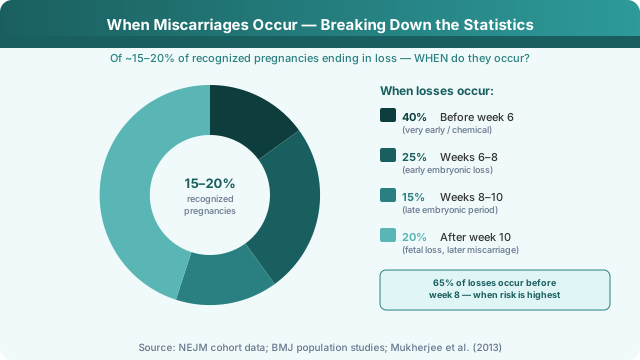
The "1 in 4" headline is problematic for a specific reason: it implies a flat probability throughout pregnancy, when in fact risk is highly front-loaded.
At week 4 of a recognized pregnancy, risk is around 20–25%. By week 8, it has already fallen to 5–7%. By week 12, it is around 2–3%. By the second trimester, risk of loss is well below 1%.
Using the overall first-trimester average to estimate risk at week 9 is like using the national speed limit to estimate how fast you are going on a residential street. The average is technically correct for the whole first trimester but tells you nothing useful about right now.
This is precisely why our miscarriage risk calculator provides week-specific estimates rather than trimester averages. If you are 9 weeks pregnant with a confirmed heartbeat and no other risk factors, your risk is closer to 2–3%, not 20%.
The Hidden Variable: Age
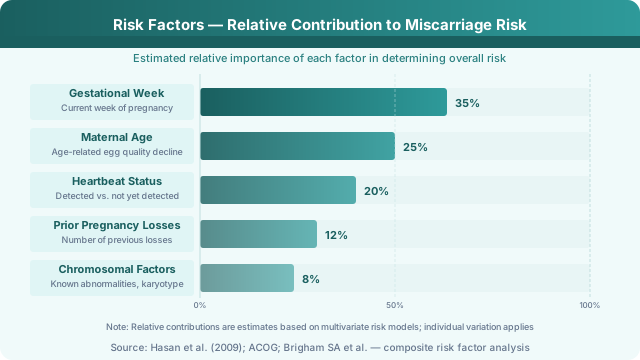
Population-level statistics mix together all ages. When a study reports "10–15% of recognized pregnancies miscarry," that includes the ~1% risk of a healthy 28-year-old at 10 weeks with a confirmed heartbeat and the ~20% risk of a 45-year-old at 6 weeks with no heartbeat yet detected.
These are not the same population, and treating them as if they are produces an average that is useless for almost everyone.
Age-specific rates from Nybo Andersen et al. (2000), which studied 634,272 pregnancies, show:
- Under 30: ~10–12% overall first-trimester loss
- 30–34: ~12–15%
- 35–39: ~17–20%
- 40–44: ~25–30%
- 45+: ~40–50%
These are whole-trimester averages that include early high-risk weeks. For a 42-year-old at week 10 with a confirmed heartbeat, the risk is substantially lower than the 40–44 whole-trimester figure suggests.
The Recurrence Question
Another area where statistics mislead: "Will it happen again?" Most people who experience one miscarriage ask this question. The reassuring answer: experiencing one miscarriage does not substantially change your odds in a subsequent pregnancy.
The data from Brigham SA et al. (1999) shows:
- After 0 prior losses: approximately baseline risk (~10–15% across first trimester)
- After 1 prior loss: approximately 1.3× baseline (~13–19%)
- After 2 prior losses: approximately 1.8× baseline (~18–27%)
- After 3 or more prior losses: approximately 2.3× baseline (~23–35%)
One prior loss is a modest risk factor. Three or more is clinically significant and warrants investigation. But even then, most subsequent pregnancies succeed.
Population Statistics vs. Your Pregnancy
Here is the most important framing: population statistics describe what happens across large groups of people. They do not determine what will happen in your specific pregnancy.
A 3% risk at week 9 means that roughly 97 out of 100 people at your week, age, and with your history have ongoing pregnancies. It also means that 3 out of 100 do not. And if you are reading this after a loss, you know firsthand what it feels like to be in that 3%.
Numbers help contextualize risk but do not make individual outcomes predictable. What they can do is give you a framework for decision-making: when to have an early scan, how to interpret a symptom, when to feel relatively reassured.
Use our miscarriage risk calculator to see where your current pregnancy sits within the statistical picture. For more context on what drives these numbers, our article on chromosomal abnormalities and miscarriage explains the biology behind the statistics.
How to Read Pregnancy Statistics Without Panic
Most of the pregnancy statistics you'll encounter are written for researchers, not patients. A few reading habits turn a scary number into a useful one.
Absolute risk vs. relative risk. "Doubles your risk" sounds alarming but means nothing without a starting point. If a factor doubles risk from 1% to 2%, you've gained 1 percentage point of risk. If it doubles it from 20% to 40%, that's 20 percentage points. Always ask: 2× of what baseline? News headlines almost always report the relative figure because it sounds larger. The Brigham et al. (1999) data on recurrence shows a 1.3× relative increase after one prior loss, but the absolute increase is only 3–4 percentage points for most women.
Averages hide the individuals. A 12% first-trimester loss rate is an average across weeks 4 through 13. It mixes a 25-year-old at week 5 with no heartbeat confirmed into the same figure as a 38-year-old at week 11 with a confirmed heartbeat. Those 2 people have very different actual odds. When a statistic doesn't specify age, week, and heartbeat status, it's describing a group you probably aren't in.
Cumulative risk vs. weekly risk. A 10% first-trimester risk means 10% across 10 weeks combined, not 10% at every week. The per-week risk at week 11 is well under 1%. Cumulative figures are useful for research, but if you're trying to answer "what's my risk this week?" you need the weekly version.
Questions worth asking your OB. Four that produce clearer answers than "is everything okay?" are: "Given my age and week, what is my current week's risk?", "Does this specific finding change that number, and by how much in absolute terms?", "What would actually change my management?", and "If this test comes back abnormal, what happens next?" The third question separates information that matters clinically from information that's only anxiety-producing. If the answer is "nothing would change," you probably don't need the test or the conversation at that moment. The fourth helps you decide whether you're ready for the answer before the result arrives.
Sources: Wilcox AJ et al. (1988). Incidence of early loss of pregnancy. NEJM. Nybo Andersen AM et al. (2000). BMJ. Brigham SA et al. (1999). Human Reproduction. ACOG Practice Bulletin No. 200.