Chemical Pregnancy vs. Miscarriage: What's the Difference?
A chemical pregnancy is a very early pregnancy loss, often before a missed period. This guide explains the clinical distinction, why it matters, and what it means for future pregnancies.
Quick Answer
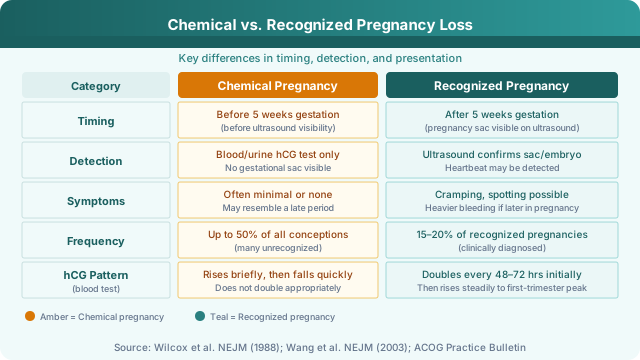
A chemical pregnancy is a miscarriage that occurs before 5 weeks gestational age, before the embryo is visible on ultrasound. It is called "chemical" because the only clinical evidence is a positive biochemical test (hCG). Most chemical pregnancies look indistinguishable from a late or slightly heavy period. The distinction matters for statistics but not usually for clinical management.
A chemical pregnancy is a very early pregnancy loss detected only by a positive hCG test, with no ultrasound confirmation of an embryo. Modern home pregnancy tests can detect hCG levels as low as 10–25 mIU/mL, sometimes 2–3 days before a missed period, at levels that would have been undetectable by tests from 20 years ago. This improved sensitivity has created a new category of pregnancy awareness that didn't exist a generation ago.
Understanding what a chemical pregnancy is, how it differs from a clinical miscarriage, and what it means for future fertility is important for anyone who has experienced one.
What Is hCG?
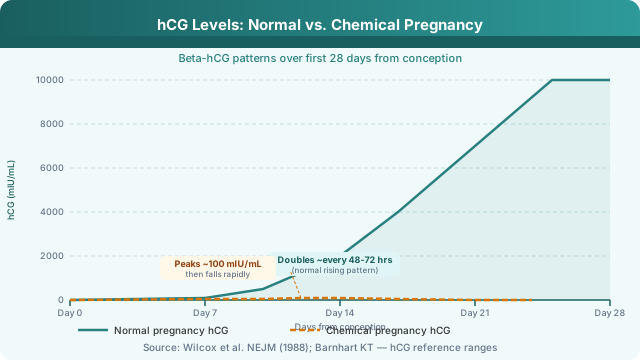
Human chorionic gonadotropin (hCG) is the hormone that all pregnancy tests detect. It is produced by the trophoblast cells that will eventually form the placenta, beginning within days of implantation. hCG typically doubles every 48–72 hours in a healthy early pregnancy.
A positive pregnancy test, by definition, means detectable hCG. But hCG can be present from implantation (about 10–12 days after ovulation) even when the embryo subsequently fails to develop normally.
Defining a Chemical Pregnancy
A chemical pregnancy is defined as a pregnancy where hCG was detectable (positive test) but:
- The pregnancy was lost before 5 weeks gestational age, and
- No embryo was ever visible on ultrasound (or no ultrasound was performed)
The loss often occurs before the expected period date, or within a few days of it. Clinically, it presents as a period that arrives on time or slightly late, sometimes heavier than usual, sometimes with brief spotting before a more normal bleed.
The term "chemical" is considered outdated by a growing share of clinicians and patient advocates, because to the person who saw a positive test, it was a real pregnancy and a real loss, regardless of how early it occurred. However, the clinical distinction is still used in research and hospital documentation.
Defining a Clinical Miscarriage
A clinical miscarriage (also called a "clinical pregnancy loss") occurs when:
- The pregnancy has been confirmed on ultrasound (a gestational sac, yolk sac, or embryo is visible), or
- The loss occurs after 5–6 weeks gestational age, when these structures would normally be visible
Clinical miscarriages are what most people think of when they hear "miscarriage": a loss that occurs after the pregnancy was visible on scan, often with more significant physical symptoms (heavier bleeding, cramping, passing tissue).
The distinction between chemical and clinical affects how losses are counted in research studies. Most published miscarriage statistics count clinical miscarriages (5+ weeks), which is why the commonly cited 10–15% figure differs from the 25–30% figure that includes chemical losses.
Why the Distinction Matters
For statistics and epidemiology:
Studies that only include clinical pregnancies report lower loss rates than studies that include chemical pregnancies confirmed by sensitive hCG testing. When you read that "10–15% of pregnancies miscarry," this typically excludes chemical losses. When you read "up to 30%," it includes them.
Our miscarriage risk calculator is designed for recognized pregnancies of 4 weeks and above, and the risk estimates are calibrated to recognized pregnancy data. If you are at week 4–4.5 with only a positive test and no ultrasound confirmation, your estimate will reflect the higher early-week risk that includes chemical-pregnancy-like losses.
For clinical counting:
Whether a chemical pregnancy "counts" as a miscarriage for recurrent pregnancy loss (RPL) diagnosis is debated among specialists. Most RPL guidelines, including the 2018 ESHRE guideline, require two or more losses confirmed by ultrasound or clinical evaluation, not just positive hCG. However, reproductive endocrinologists often take chemical pregnancies into account when a pattern of 3 or more biochemical losses suggests implantation failure.
For the person experiencing it:
A chemical pregnancy is a real loss. The grief is valid regardless of gestational age. At the same time, chemical pregnancies often do not require the same medical management as later miscarriages; no intervention is typically needed, and the physical recovery is usually rapid (one normal menstrual cycle).
Does a Chemical Pregnancy Affect Future Risk?
One chemical pregnancy does not substantially change your odds in a subsequent pregnancy. The risk multiplier for one prior loss (1.3×) applies to documented prior losses, and even if counted, a single prior chemical pregnancy has a minor effect on your individual risk estimate.
Recurrent chemical pregnancies (three or more early biochemical losses) may be a sign of implantation failure and warrant evaluation by a reproductive endocrinologist. This is distinct from RPL as typically defined but can indicate issues with uterine lining, embryo quality, or immune factors.
When to Follow Up
After a single chemical pregnancy with no prior losses, most clinicians recommend no specific follow-up before trying again. Ovulation typically resumes within 2–4 weeks, and trying again in the next cycle is safe.
If you've had two or more chemical pregnancies, or a combination of chemical and clinical losses, discuss this with your OB/GYN. A referral to a reproductive endocrinologist may be appropriate to rule out implantation issues.
For more on the recurrent loss workup, our guide to recurrent miscarriage causes covers what testing is available and what it shows.
Use our miscarriage risk calculator once you've confirmed an intrauterine pregnancy on ultrasound for the most relevant risk estimate for your stage.
When to Take a Pregnancy Test After a Chemical Loss
After a chemical pregnancy, the body usually resets faster than after a clinical miscarriage. hCG falls below test-detectable levels within 7–14 days in most cases, and the next menstrual cycle tends to follow a familiar pattern.
hCG clearance. Because chemical pregnancies rarely push hCG above 100 mIU/mL, the hormone typically clears within 1–2 weeks. You don't need formal beta hCG blood tests unless bleeding is prolonged beyond 2 weeks or your clinician asks for them. A negative home test 10–14 days after the bleeding started is usually sufficient confirmation.
When ovulation returns. Roughly 80% of people ovulate within the first cycle after a chemical pregnancy, with the median time to ovulation falling near day 14–21 after the bleed begins. This is faster than recovery after a clinical miscarriage, where ovulation can take 4–6 weeks. If your cycles were regular before conceiving, expect them to return to that rhythm within 1–2 cycles.
When to test next. If you're trying again right away, the 2 main options are:
- Test 14 days after suspected ovulation. This gives a reliable result on a standard sensitivity test (20–25 mIU/mL).
- Test on the day you would have expected your next period. Less stressful for those who track cycles loosely.
Avoid testing in the 7–10 days immediately after the bleed. Residual hCG from the chemical loss can produce a faint line that is not a new pregnancy and can trigger unnecessary worry.
Expect a normal cycle. The first period after a chemical pregnancy is usually within 1–3 days of the expected date. About 1 in 4 people report that this first period is slightly heavier or crampier than usual, then returns to baseline by the next cycle. If your period is more than 7 days late or significantly heavier than a typical heavy period, call your OB/GYN to rule out retained tissue or a new pregnancy.
Is it safe to try again immediately? ACOG and the World Health Organization agree that there is no medical reason to wait after a chemical pregnancy. Older guidance recommending a 3-month wait has not held up in research; conception in the first cycle carries the same live-birth probability as conception 3 months later.
Sources: Wilcox AJ et al. (1988). Incidence of early loss of pregnancy. NEJM, 319:189–194. Edmonds DK et al. (1982). Early embryonic mortality in women. Fertility and Sterility. ACOG Practice Bulletin No. 200 (2018). ESHRE Guideline on Recurrent Pregnancy Loss (2018). Schliep KC et al. (2016). Trying to Conceive After an Early Pregnancy Loss. Obstetrics & Gynecology, 127(2):204–212.